The term innovation has become one of the most over-used words in the business world. Innovative is a trait that almost every organization desires to have. Businesses come out with new software, integrate AI, streamline repetitive tasks, and invest in digital platforms to stay competitive. Such changes are frequently described as improvements. A genuine question that needs to be asked is: "Are businesses solving problems or are they just putting more technology in place?" Adopting technology and innovation is not one and the same. Introducing a new tool involves integration into a current system. Real innovation is not a simple change or a mere refinement of a product or service, but the enhancement of it, the solution to a problem, or the generation of value never before seen. Some sophisticated systems can be installed in a company and yet remain with the same inefficient processes. Otherwise, it's updated its tools, but not its thinking.
The Digital Age in the Lived Experience of the Information Age
In today's business world, one of the major challenges is to keep pace with the technological changes. The moment competitors state their initiatives in artificial intelligence or projects automation, organizations may feel that they have to do the same. Some of the decisions are made because they are afraid of being left behind and not because they know what the business needs.
This results in the use of technology for looks. A business might adopt an AI chatbot even if customers are still requiring human assistance to resolve their actual issues. The team can still buy project management software and still have unclear responsibilities and poor communication. It is possible for the process to be automated, but was poorly conceived to begin with.
A strategy is the only thing that technology can't replace.
Is the average person becoming too lazy to think?
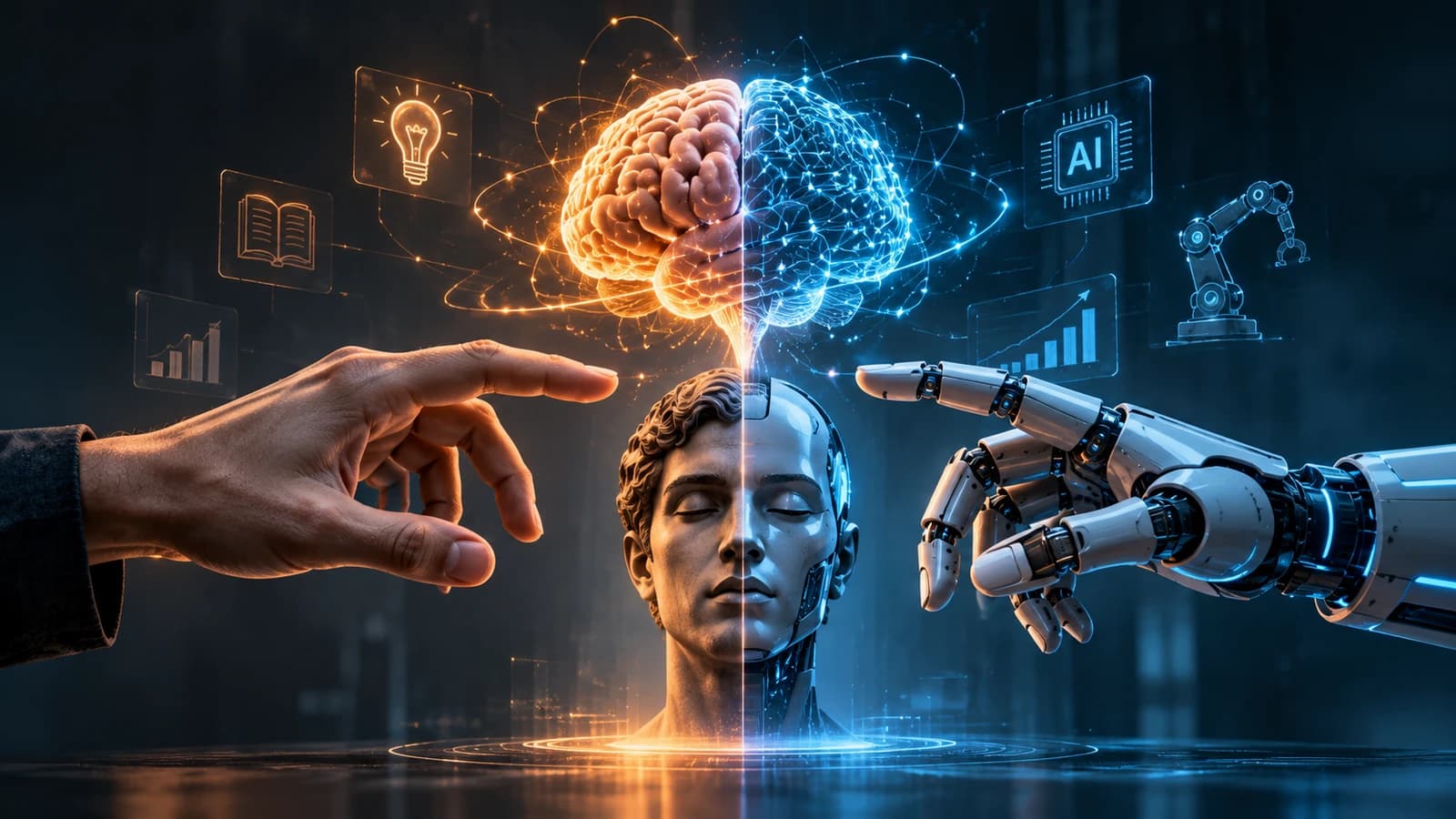
It's not just about business operations. Digital tools are becoming more powerful and are increasingly being used to make decisions, to develop opinions, to brainstorm ideas, to solve problems and to complete tasks. AI can write an email or answer a question, create a report or even give a strategy in seconds. This is useful, but can be dangerous because we could start to shy away from the thinking that should take place before seeking an answer. But the fact that human intelligence is not vanishing and that technology itself is not to blame. The question is: What if help replaces hard work? The development of critical thinking occurs when one challenges information, considers alternative perspectives, makes mistakes, and tries to solve problems that are challenging. When we take the first answer generated, we miss the important process of checking the reasons.
Sparrow, Liu and Wegner (2011) have found that if individuals think they can access information on-line, they will be more likely to remember where it is and less likely to remember the information itself. This isn't a reflection of a lack of intelligence among Internet users. It does, however, reveal the potential of technology to alter our memory of and focus on what. Likewise, with automated recommendations. Goddard, Roudsari and Wyatt (2012) conducted a systematic review of automation bias, defined as the tendency to trust automated systems over error or information that is inconsistent with the automated systems' recommendations. While the focus was decision support settings, the lesson has relevance in other settings. If they come to trust a system too quickly, getting used to the ease of use may lead to a reduced habit of determining whether its answer is correct. But the danger is more pronounced in the case of generative AI. Requesting an explanation from a tool can facilitate learning of a hard concept. It's not the same when you ask it to do all the hard work, but you don't try to understand the outcome. One way carries people think, another way makes it optional. It's not the tool, it's what the tooler gives away.
More Tools, More Complexity, Less Progress
Companies can too fall into the identical trap. Every new platform brings with it the promise of efficiency, but each one brings with it the need for implementation, training, maintenance, integration and oversight. If systems are implemented without a specific purpose, staff might be spending more time switching between applications, looking up duplicated information or managing workflows, than working productively.
This is where organisations mix up activity with achievement. A larger technology budget, more automated tasks or more digital tools might seem a good thing to add to a presentation. None of these alone are a guarantee of improved service for customers, increased productivity for employees or decision-making improvements.
The OECD research on digital technology diffusion (2026) points to skills, education and existing digital capabilities as factors that are associated with the ability of firms to benefit from advanced technologies. The point is not that all organizations need to use all of these new technologies.
That adoption is best when people and processes are ready.
What it means to be genuinely innovative
A problem is the starting point of innovation, not a product demonstration. Organizations need to ask themselves what is currently not working in their organization, who is being impacted, and if technology is the answer, before investing in a new system. At times, the solution might be automation. Other times, it could be just a matter of better communication, streamlined processes, training employees or a shift in management.
Also, it is essential to measure results, not announcement.
Have there been fewer errors in the new system?
Has it enhanced the customer's experience?
Does it provide more time for employees to do more work that involves judgement and creativity?
Most importantly, human judgment should be in play. Technology should increase and not take away the need for thinking. Organizations should have staff members who can critically evaluate what the system is producing, identify their limits, and be able to make decisions as the system doesn't always have the bigger picture.
References
- Goddard, K., Roudsari, A., & Wyatt, J. C. (2012). Automation bias: A systematic review of frequency, effect mediators, and mitigators. Journal of the American Medical Informatics Association. https://pubmed.ncbi.nlm.nih.gov/21685142/
- Sparrow, B., Liu, J., & Wegner, D. M. (2011). Google effects on memory: Cognitive consequences of having information at our fingertips. https://pubmed.ncbi.nlm.nih.gov/21764755/
- OECD (2026). Digital Economy and Society Outlook. https://www.oecd.org/en/publications/oecd-digital-economy-and-society-outlook-2026_022ed474-en/full%e2%80%a6.html