Walk through an operations floor and you may notice something odd. After years of investments in automation, people still spend much of the day copying numbers between screens, chasing exceptions and answering the same customer questions.
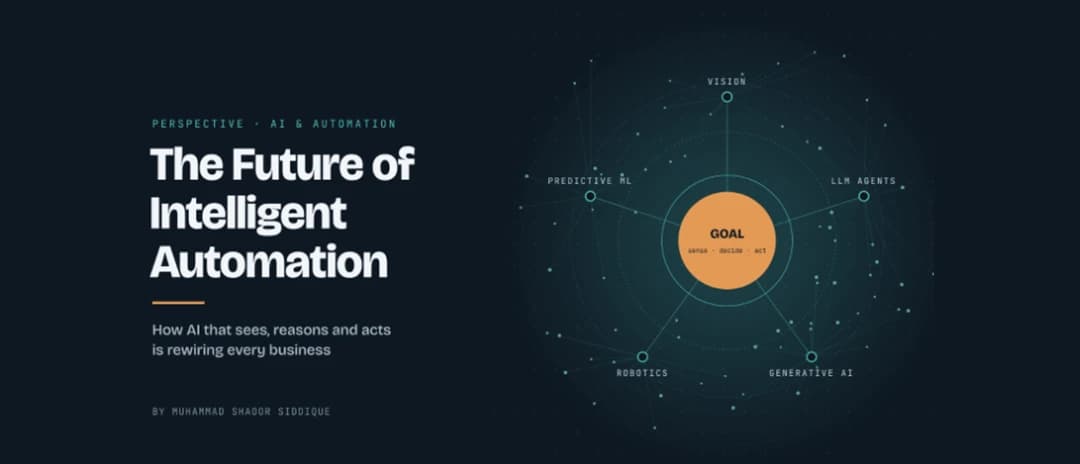
That's starting to change. AI systems can now interpret the unstructured emails, identify visible damage to a parcel in a photograph, and assess refund requests against defined policies tasks that previously relied on human review. McKinsey estimates that generative AI could create between $2.6 - $4.4 trillion in annual economic value across the available case studies [1]. For businesses, the practical opportunity lies in connecting these capabilities to operational systems and directing them towards clearly defined goals.
From scripted steps to defined goals.
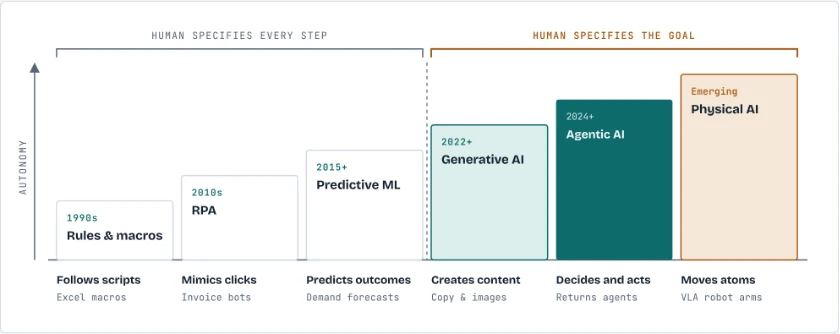
Traditional business automation often required people to define each step-in advance. Macros executed predefined commands, while robotic process automation (RPA) bots followed configured workflows that could fail when an application’s interface changed.
Large language models (LLMs) have expanded what these systems can do. Rather than scripting every step, it can specify an outcome, such as resolving a customer’s delivery problem. Combined with access to tools, relevant context and a planning loop, a language model can form the basis of an AI agent that selects and carries out actions within defined limits. However, the existing automation still plays an important role, the agents can use RPA bots and forecasting models to complete routine tasks and to decide when to use them.
The layers behind intelligent automation.
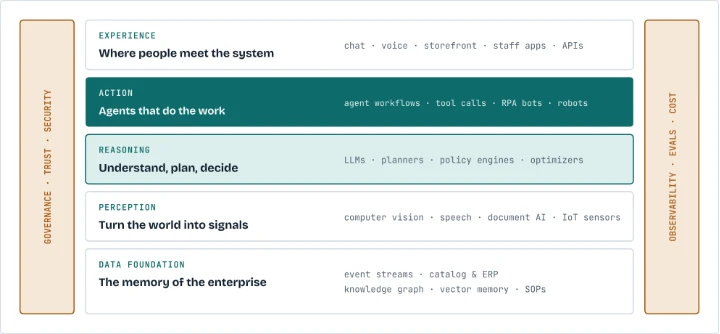
Intelligent automation is easier to understand in layers, where the data forms the foundation and the perception tools, such as cameras, speech recognition and document readers, converts the incoming information into usable inputs. The reasoning layer uses language models to interpret those inputs and plan actions, while APIs, bots and robots carry out the tasks. Governance and monitoring operate across all layers. Projects can stall when companies invest heavily in the model but neglect the data, integration, and controls around it.
How an agent works, and where people fit-in.
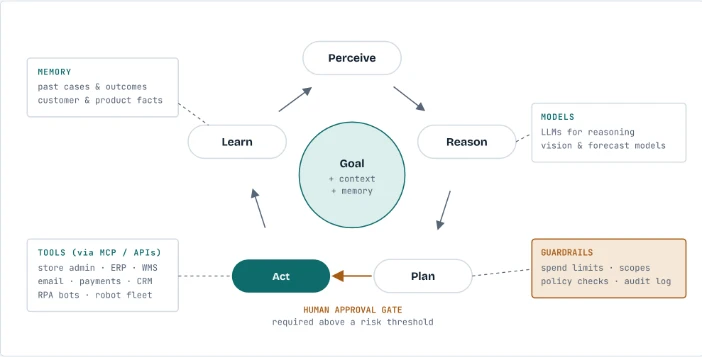
An AI agent follows a repeated cycle: assess the situation, plan its next steps, act through available tools, and check the results. Language models help in applying this approach to a wider range of the tasks. The Model Context Protocol, introduced by Anthropic in November 2024, provides a common interface for connecting AI applications to external tools and data, including configured connections to CRMs, ERPs and commerce platforms [2].
Klarna illustrates both the opportunity and the importance of human support. In early 2024, the company reported that its AI assistant handled two-thirds of customer service chats in its first month, equivalent to the estimated workload of 700 full-time staff [3]. In May 2025, its CEO emphasised the need to retain access to human support [4]. The lesson is more practical that effective hand-offs to people matter as much as the model. Gartner predicted in March 2025 that agentic AI would resolve 80% of common customer service issues without human intervention by 2029 [5]. The direction is clear, even if the road is bumpy.
Where businesses are applying intelligent automation.
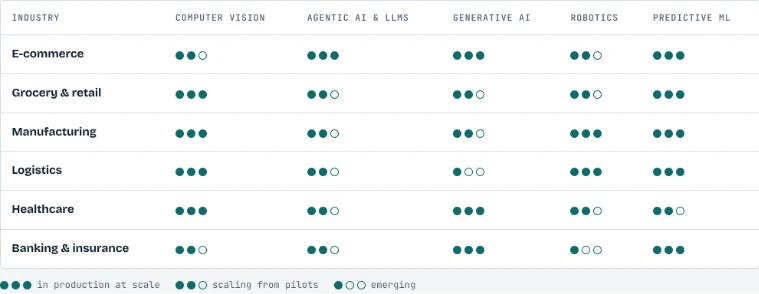
E-commerce and Shopify storesFor small online brands, a team of five can start to operate like a team of fifty with the help of Ai tools. Shopify's Sidekick lets merchants ask questions about their store in plain language and get admin tasks done [6]. Product copy gets drafted for each market in minutes, and customer service agents can handle routine quires, order tacking, and returns within the store's policy.
Beyond this, there is a second shift coming that many merchants aren’t ready for. Customers will increasingly use their own AI assistants to compare products, and if your product data is incomplete, or incompetent, they will simply by-pass you.
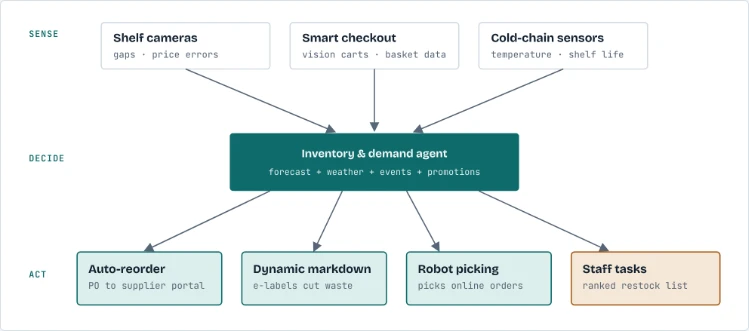
Grocery and retailThin margins and perishable stock make grocery a practical setting for automation. Shelf cameras spot gaps and pricing errors, and an inventory agent combines that with the forecast, places the reorder, cuts the price on stock close to its sell-by date, and sends staff a ranked list of what to restock first. On the fulfilment side, Ocado's warehouses use swarms of robots on a grid to pick online orders in minutes [7].
On suitably equipped factory lines, vision systems can inspect every unit instead of relying on sampling, and maintenance agents can read a sensor alert, review the past work orders and help schedule repair. Additionally, the vision-language-action models, such as Google DeepMind's Gemini Robotics allow robots to follow plain-language instructions and handle objects they weren't explicitly programmed for [8].
Healthcare and financial servicesIn clinics, ambient documentation tools draft consultation notes for doctors to review, reducing time spent on paperwork. In banks also the agents assemble claims and know-your-customer (KYC) files. People remain responsible for decisions, while automation reduces the work involved in preparing and organising information.
Why so many projects stall
Successful automation requires more than a capable model. Gartner expects more than 40% of agentic AI projects to be scrapped by the end of 2027, mostly because of rising costs, unclear business value or weak risk controls [9].
Three practices can address these risks. First, review and improve the process before automating it, because a chatbot on top of a broken process just gives you a faster broken process. Second, define what the agent can do independently, which actions require approval, and which decisions remain with people, with all actions logged. Third, measure performance from day one including cost per resolved task, accuracy and escalation frequency. These measures provide the basis for deciding whether a system is ready to scale.
The real question is no longer what we can automate. It's which decisions we're comfortable handing over, and on what terms.
Future perspective
Over the next five years, more knowledge workers are likely to supervise AI agents as part of their roles and companies will compete on the quality of their automated decisions almost as much as on their products. Human judgment will remain a critical source, particularly for complex decisions and exceptions, and the companies that reshape their work accordingly will be in a better position to set the pace.
References
- McKinsey & Company, The economic potential of generative AI: The next productivity frontier, June 2023.
- Anthropic, Introducing the Model Context Protocol, November 2024.
- Euronews, Klarna's AI bot is doing the work of 700 employees, February 2024.
- Finextra, Klarna rethinks AI customer service push as CEO acknowledges value of human touch, May 2025.
- Gartner, Gartner predicts agentic AI will autonomously resolve 80% of common customer service issues by 2029, March 2025.
- Digital Commerce 360, Shopify's Sidekick AI assistant update, May 2025.
- Ocado Group, Ocado Smart Platform: our technology.
- Google DeepMind, Gemini Robotics, March 2025.
- Reuters via The Star, Over 40% of agentic AI projects will be scrapped by 2027, Gartner says, June 2025.